Showing posts with label money. Show all posts

Friday

Steve Jobs, Apple, the iPad, and King Gillette

On Wednesday, after much hype and drama, Steve Jobs walked onstage and unveiled Apple’s latest creation - the iPad. Having watched almost every key address for Apple for many years I, like many others, were disappointed that the product didn’t live up to the hype. Nonetheless, Apple will sell a boatload of these products, but not as many as the iPhone.

Upon reflection, it occurred to me that Steve Jobs is changing the whole business model of Apple and I don’t believe anyone has caught on to this yet.

In all the reports I’ve read after the launch of the iPad, I think every writer /analyst missed this key point: Steve Jobs wants to be like King Gillette.

If you don’t know who King Gillette was, you may not old enough to shave. King Gillette started his business at the beginning of the century. His business model is what I believe Apple’s business model will be in the future.

Long ago, King Gillette decided to practically give the razor away at or below cost, but sell the razor blades separately.

So here’s what I think, I think Apple wants to give the iPhone and the iPad to as many people as possible at cost or with a small profit. Remember now, AT&T subsidized the iPhone and Apple gets a slice of the pie from every AT&T customer that has an iPhone. Now why would they do that you might ask?

The key reason, I would argue, is that Apple wants the magic of recurring revenues. This is the dream of many companies - to have millions of folks paying a small amount of money every month for using a service. What makes Apple stand out is the fact that they have an army of developers who are writing code for some very cool apps. Yes, there is an app for that. In fact, there is an app for almost every idea ever thought of.

Not only has the app store been widely successful, but Apple also has iTunes, and iBooks along with iTV coming down the road. So this is what I believe Apple’s business model is going to be: with 125 million people who have giving Apple their contact and credit card information, Apple has a huge base of customers much like the newspapers and magazines did in the ’60s and ’70s, but on a much smaller scale. Now Apple can upsell products to those customers at will. The genius part about all of this is the fact that other people are creating products to be sold through the Apple store. Apple just reinvented the King Gillette model in a thoroughly modern way. Hat’s off to you Steve.

That’s my take on Apple’s stealth business model.

Now let’s take a look at the stock.

In my short video, I explain to you some key factors I’m watching that I think will make the difference in this market. If you have a few minutes, please take the time to watch this juggernaut of a stock and what I think is ahead for the market in the next 2 months.

As always videos are free to watch and there is no registration required.

The only request that we make is that if you find the video interesting or even disagree with the analysis, please comment on a blog. We would love to hear from you.

All the best,

Adam Hewison
President, INO.com
Co-creator, MarketClub

Tuesday

Fibonacci, Crude, Gold and Money

You may have heard about Fibonacci, the man who discovered a set of numbers which have been found to have a major affect on the market. So who is this Fibonacci fellow and why are his findings so important in the market place?

The mathematical findings by this thirteenth century Italian man has yielded a useful tool which is used in technical analysis and by scientists in a large array of fields.

In our new short video, I will look at gold and also the crude oil market using MarketClub’s Fibonacci tool. I think you will be surprised and shocked at just how accurate and up-to-date this dead mathematician’s work is in today’s markets.

This is such an important video that we only want to leave it online for a short time. We urge you to take 4 minutes and learn the Fibonacci secret to the markets.

There is no need to register for this video and of course you can watch it with our compliments, but you must act today otherwise you risk missing out on this key element to the market.

Enjoy the video and please give us your feedback on this blog.

All the best,
Adam Hewison

Some Forex Philosophy

Works With Stocks Too!!

I remember one of the smartest human beings I’ve ever mentored, in my 15 years in the markets, explaining a trade he wanted to place. Let’s call him “Neal.” Neal told me that the Fed needed to raise rates immediately and he was piling up long USD. Well, the rate rise never came, but he made $1oK on his position anyway. The market was pricing in a larger rate rise in the future. He then prances around my trading room like a show horse, talking about how he was right for taking such a large long position. I walked over to him and proceeded to tell him that we were taking the money out of his account. “What?! Why?!” exclaimed Neal. “Because you were wrong. You said the Fed was going to raise rates immediately and they didn’t,” I told him, “so you have to give the money back.”

Obviously, we didn’t take the money from Neal but the point, I believe, is a strong one. In trading, focusing on being “right” will get you a cup of coffee and a few hours in front of the help wanted section of Craigslist. Right is ego and that has no business in a trader’s working day. If you want to be “Big shot trader,” do it at the bar at The Four Seasons Hotel on the weekend.

In successful trading, there is no “right,” only good trades and bad trades. As you grow as a trader, you want to eliminate as many bad trades as human nature will allow. It is possible to lose money on good trades and make money on bad trades but as time goes on, the more you eliminate the bad trades and put on the good ones, the more money you will make. What makes a “good trade”? It’s a combination of discipline, risk/reward, money management and internal honesty. Looking inward to see if you are in a trade because you want to prove (to others or to yourself) just how smart you are or because you did your analysis, calculated risk/reward and decided that this was the best trade the market offered you. Have you ever walked up to your screen with a position in mind only to find the charts or the fundamental news told you something different? Which trade did you put on? Were you able to face that your opinion was wrong and put on the good trade that the market was offering you?

Most successful traders that I know in the modern age have varying levels of personal ego, but very little trading ego. They are fine with a loss and know that the market will not save them from themselves. The days of the big swinging pit trader, pushing the market around, are over. There may be funds and institutions that can temporarily affect market direction, but the Forex market is too large and will always go exactly where it is supposed to be. Do your research and be disciplined in your trading plan and leave Neal, the prancing show pony exactly where he belongs…in the barn.

Bob Iaccino
TraderOutlook.com

Sunday

Using Limit Orders

So you’re new to investing. Or maybe you’re an intermediate or perhaps even an advanced trader. Regardless of where you are in your investing career, there’s one trick that I’ve learned through the course of my investing experiences that really helps me gain a slight edge every time I trade. Over time, this strategy leads to a pretty significant amount that could be added to your overall gains.

Most of you are already well aware of the limit orders. Unlike the very basic market orders that let you purchase a stock at the current “market” price, limit orders allow you to buy or sell shares at a specified price or better. Limit orders also allow an investor to limit the length of time an order can be outstanding before being canceled.

So what’s the big deal? You already know about it? Sure, using limit orders is rather simple and nothing very advanced. Most people use it from time to time to get into a position at a certain price. What I challenge you to do however is to look back at your past security purchases and tally up how many market orders you placed over the last year. I bet you’ve had many of those in the past. I, for one, realized most of my trades were executed at the market price.

What I’m going to discuss today is one of the simplest tactics you can use to gain a slight edge every time you trade and convert it into a big gain in the long haul.

Example:

Let’s say you’ve analyzed the current market condition, eyed on a stock to purchase (call it ABC) with the conviction that you will profit. You decide to get into ABC at around $5 per share with an exit target price of $7. A few days later the stock nears the target price of $5. Here comes the execution, and you hit your “place order” button at a market price. You get a confirmation email stating something like:

Trade type: BUY - Market order
Security symbol: ABC
Quantity: 1000
Price: $5.08

At this point you spent $5080 purchasing 1000 shares of ABC. You executed according to plan right? Sure, I would say that was a pretty good execution given you executed to the plan formulated. That alone puts you well ahead of many investors who go into a position without too much thought, yet alone an entry and an exit plan. However, if you are like me when I first started trading, you most likely purchased the stock at the market price… Now this is where I want to challenge you to have a new perspective. Let’s look at a very similar scenario, but with a limit order instead:

Trade type: BUY - Limit order
Security symbol: ABC
Quantity: 1000
Price: $5.06

What if you had actually placed a limit order to buy slightly below the current trading place at the time of execution? Whether you’ve observed this or not, stock price usually fluctuates within a small range as the price trades up or trades down. It’s certainly not always true, as stocks can quickly change their course from time to time, but you’ll quickly start to realize that opportunities exist on many of the trades you plan to make.

In this case, even though it’s only a 2 cents difference, you now spent $5060 instead of $5080. Some of you are saying “hell it’s only $20, what’s the difference?” It’s certainly a very marginal amount for a one time trade, but imagine the long-term benefit if you challenge the stock market with this mindset every trade:

10 trades a month x $20 savings = $200/month

$200/month x 12 months (1yr) = $2400/year

$2400/year x 3 years = $7200 of potential “savings”

This of course assumes you get to save $20 per every trade, but what matters is the concept. Regardless of whether you save a penny per share or even a dollar per share on highly volatile stock, the opportunities to gain more money by using limit orders are out there. If you equip yourself with this mindset every time you trade, I guarantee you will find opportunities.

Here are some tips on when to employ this limit order strategy and when not to:

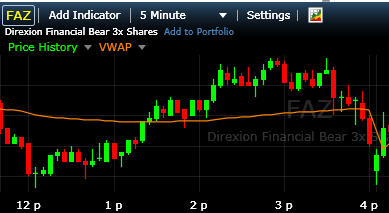
Do Use Limits – When the stock is in a consolidation stage intra day and moving in a tight range, up and down.
limit order

5 min chart

Do Not Use Limits – When the stock is in a trading/trending stage intra day and moving upward or downward quickly. The chances are, your limit orders will be left behind.
limit order 2

5 min chart

I challenge you to think about this next time you’re planning to buy or sell a stock at the market price.

Best of luck in the markets,

Hiro

My10000dollars.com

Tuesday

Proper Position Sizing

Proper position sizing is something many traders never even think of, let alone learn to master.

To determine our positions size we must first set a stop level. This should be a logical place which will be out of range of normal market movements, and if hit will be at a level where we know we are wrong about the direction of the market. Remember, a trader should not risk more than 1-2% of capital on a trade. Less is better. Larger accounts are likely to risk much less than 1% of capital on many trades. They may do this by selecting a fixed dollar stop which is less than 1% of their account.

If our account is $5000, we can have a maximum loss of $100 if we risk 2% of our capital on the trade. Let’s say we choose a stop which is 50 pips below our entry buy price. From this information we can determine our proper position size; we can take a maximum of 2 mini lots. If our stop is hit, we will lose 50 pips X 2 mini lots, or $100 which was our maximum loss.

Taking 2 mini lots on this trade allows us to have an ideal stop (this will be different for each trade) and keep our risk in check. As our stop (or risk level) increases on the trade, our position size will decrease, and as our risk (on the trade) decreases our position size can increase. As our account grows our position sizes will also generally increase as we are able to risk more capital on each trade.

Whether we risk a percentage of our account on each trade, or choose a fixed dollar amount we are willing to risk on a trade (for larger accounts) the method above should be employed to determine the proper position size based on the stop level which is ideal for the trade. This means each trade may be for different quantities, depending on the dynamics of the trade set up.

To learn more about my writings and follow my blog posts you can view everything at darkpooltraders.com an active community of professional traders.

Best,

Ron Chernesky

Friday

Forex Analyzed

Today looks like it may be a good day to swing back to trading stocks. The forex market is always there 24 hours a day 5 days a week when the stock market isn't behaving.

During times of uncertainty when stocks can't find a way, and for those that don't like or are not good at daytrading, the forex provides relief and lots of profit potential.

Watch this video from Adam Hewison as he examines the forex markets and shows a quick and effective way to analyze the dollar index too. Enjoy and learn, then go make some money!!


And then again, maybe not.